
Travel Like a Local

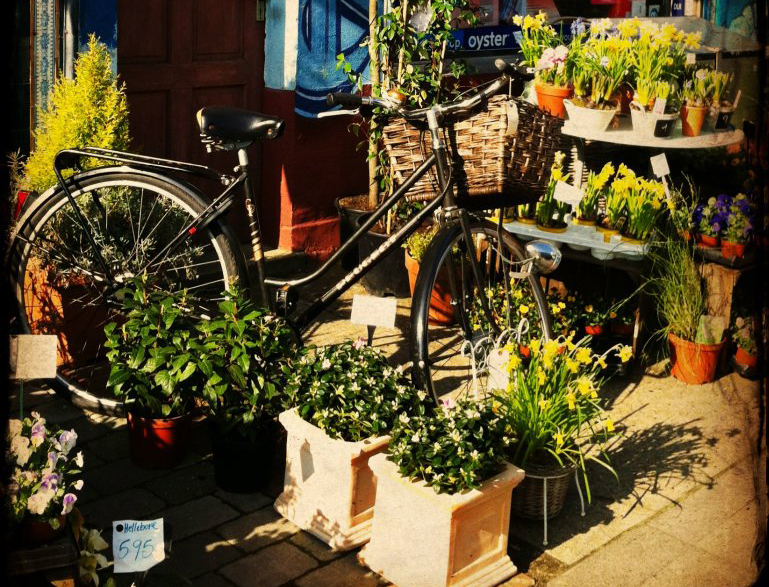
bike at the flower market

When I visit a new city, I like to pretend I live there. I want to go where the locals go, eat where they eat, and shop where they shop. I might take in a major attraction or two, but for the most part I try to avoid the other tourists (or touristas as my dad calls them) and find a city’s hidden gems. As soon as I step out of my hotel, I think to myself, if I lived here where would I go?

Here are my tips for traveling like a local. 

Gasthof Goldener Greifen in Rothenburg, Germany

Gasthof Goldener Greifen in Rothenburg, Germany

1. Skip the chain hotels and stay in a B&B, guest house, or local boutique hotel. I find these have much more charm than the typical chain hotel. Several years ago, my husband and I toured Bavaria and the Tirol region of Austria. We stayed in family-run guesthouses the entire trip. It was fantastic! The rooms weren’t fancy, but they were clean, cozy, and well cared for. Most included a wonderful breakfast each morning. I’m talking farm fresh eggs, homemade granola, and yogurt from the dairy down the street. Yum! Besides the food, the best part was getting to know the owners. We learned a lot about the people and region by staying local.

2. Ask the hotel staff where they like to eat or grab a cup of coffee on their break. Ask them about their favorite restaurants in the city.

3. Go to the local public library. When I visit a new city, this is one of the first stops I make. There’s just something familiar about a library no matter where it’s located. This a great place to find out about the place you’re visiting. The staff is knowledgable and usually eager to answer questions about their city.

4. Worship at a local church if you’re traveling over the weekend. Most churches welcome out-of-town guests. Check out a church’s website before you go to find out a little about the church. Most church websites provide service times, location, and directions, and tell you what to expect. If you’re traveling internationally or visiting a church of a different faith, you’ll want to do little research to find out what to wear and what is considered appropriate behavior. I’ve been blessed to worship with other believers all across the U.S. and on three other continents. And often I’ve been invited to lunch by church members.

293818_10150611204197218_2132261075_n

Used books found at the Portobello Road Market

5. Skip the souvenir shops.
Personally, I’d rather shop for something I’ll use when I’m home rather than collecting a bunch of trinkets that will eventually wind up in a box in the bottom of my closet. I love to hit local antique shops and flea markets, as well as bookstores and specialty shops. I have silver teaspoons from London’s Portobello Road Market, handmade jewelry from an artist in NYC, pottery from Appalachia, a couple of headscarves and a rug from Baghdad, and a cheeseboard from Brazil.

6. Talk to the locals. I’ve found this to be fairly easy, especially overseas. In my experience, people who live outside the U.S. are more communal than Americans. It’s not uncommon to be seated at a table with other diners at some restaurants. I love this! It makes striking up a conversation more natural. One evening in Germany, we ate dinner at a small restaurant. The chef and owner told us two older women would probably come in and want to sit with us due to our desired location near the ceramic stove heating the small room. We were delighted when they showed up. We spent three hours eating and chatting with these two lovely ladies and the other locals who drifted in and out.

Me and Mario, my favorite maître d’ in Athens, Greece

7. Visit a local fresh market. These are always a smorgasbord of sights, smells, and sounds. Vendors will often offer samples. I make a beeline for the cheese case. Keep in mind that in some countries you’ll want to thoroughly wash any fruit or vegetables before eating. If you’re staying in one place for several days, this is a great place to pick up snacks to keep in your room.

Cheese, glorious cheese, at the Barcelona Market

Cheese, glorious cheese, at the Barcelona Market

8. Find a favorite spot to hang out. A few years ago, Keith and I spent 10 days in Kingston-Upon-Thames, England. We discovered a local coffee shop and stopped by every morning for coffee. It didn’t take long for the baristas to recognize us. We felt like regulars by the time we left.

9. Take a walk. The best way to explore a neighborhood is by foot. Soak in the atmosphere; notice the rhythm of the city. Stroll through the park or sit on a park bench and people watch. Imagine the daily lives of the people you see.

10. Be adventurous. But be smart and stay safe.

Want a really unique trip? Try exploring the everyday side of life in a particular city and discover how the locals live. What are some of your rules for traveling like a local?

Desert Journal Day 3

This morning I headed to the DFAC for an early breakfast. I found an empty seat and was later joined by SGT Smith and SGT Geeley – two nice young soldiers. They were just back from RR in the states and headed back to Afghanistan.

Everyone here is either coming from or going to a Forward Operating Base in the Middle East. Someone said the airbase is like a giant Greyhound bus station but with airplanes instead of buses. Some 3,000 to 6,000 troops come through the base every day. Some are in and out in 24 hours, others spend multiple days waiting on a flight to their destination. It’s a massive operation. And the wait is no fun, according to Smith and Geeley. We chatted over our eggs and coffee. They did their best to prepare me for the weeks ahead.

We have to wait until 1900 to get our passports back and then we can see about getting a flight to Baghdad. I spent the day walking around the base. Everything is brown. So much brown. The base blends right in with the desert landscape. I guess that’s the point.

There’s not much to do except walk past rows of tan tents, or maybe catch a movie at the MWR (I still don’t know what that means). I did a lot of walking. Any direction you looked was all flat desert. I’m sure it’s scorching hot in the summer, but this time of year it feels amazing. There’s always a breeze, and it doesn’t get above the mid-70s.

While we waited, I spent some time with Air Force Chaplain (CPT) Dallas Little who ministers to the thousands of individuals who walk past his office. He always has a pot of hot coffee and an inviting, safe place to hang out.

Little’s focus is to provide a ministry of hospitality. “We provide a safe, comfortable place for travelers as they wait for transport,” says Little. The chaplain’s office is no more than a couple of cubicles, but they managed to create an inviting atmosphere. Visitors to this small oasis are greeted with hot coffee and, if they’re lucky, Krispy Kreme donuts. “We probably go through 25-30 pots of coffee a day.”

Little sees a lot of soldiers on their way back from R and R. For some the trip home brings more trouble than rest. “They’ve been in combat, then they go home and manifest signs of post-traumatic stress,” Little says. “This often leads to trouble with the spouse. By the time they get back here, some wish they’d never gone home.”

Little sees a lot of soldiers and marines who suffer from combat stress and PTSD. His job is to provide a listening ear. “It’s my privilege and my burden to keep anything they say to myself,” says Little. “People come to us, because they know it’s safe to come to us.”

Last year (2018), an estimated 20.2 suicides occurred per 100,000 soldiers, the highest since the Army began tracking the figure in 1980. The figure is just slightly higher than the national suicide rate. 2008 marked the fourth consecutive year suicides have increase, according to the Army’s 2008 Suicide Data report released in January.

“Last year the military had more deaths due to suicide than combat,” says Little. “These guys are eye-to-eye with death. We try to help them deal with what they’ve seen and experienced.”

It’s an intense ministry, but Little is grateful to God for the opportunity to serve others.

Desert Journal: Day 1

Instant camaraderie develops between strangers when traveling to the Middle East. As I sat at the gate waiting for my flight to Kuwait City, I noticed the nods and smiles exchanged between fellow passengers. “Where you headed?” could be heard throughout the waiting area. “Baghdad.” “Fallujah.” “Kabul.” came the replies.

I was among a handful of civilians on the flight to Kuwait. The majority of passengers were soldiers, marines and airmen headed back to the front lines to rejoin their units and platoons after much-needed R and R.

The two young soldiers sitting near me at the gate had only been home for a few days of emergency leave. Even the Army knows it’s important to mourn the loss of a loved one.

I offered my condolences for each of their losses. Dave’s* mother had lost her battle with cancer. Jim had lost a child and fiancée in a car accident. A death in the family is especially hard when one is thousands of miles from home.

They both quickly changed the subject, preferring to focus on the mission at hand—getting back to their respective units. We chatted about our destinations.

They were quite interested when I told them I was headed to Camp Victory in Baghdad to embed with the 18th Airborne. “I’m reporting on the work of military chaplains deployed overseas,” I told them.

“Our chaplain’s great,” Dave said. “Every Friday he bakes bread for us and always has hot coffee. He’s a good guy.”

It’s the small comforts that make a big difference when you’re 7,000 miles from home.

They were kind enough to brief me on life in the Army and what I could expect living at a FOB (Forward Operating Base) for three weeks.

My conversation with these two soldiers only solidified my reasoning for the importance of my assignment. Life in the military is hard. Many soldiers suffer from combat stress. Add to that the stress of trying to hold a family together with only the occasional phone call or email. Divorce rates among soldiers and marines are significantly high. Military chaplains have the privilege and burden to minister to these highly trained and hard-working warriors. But how does one minister in a combat zone? That’s the question I hope to have answered during my time in Iraq.

As I boarded my flight, I offered up a quick prayer for my new friends. “God, protect them and comfort them.”