
Author Archives: Carol Pipes
9 Leadership Lessons from Carly Fiorina
Carly Fiorina is the former CEO of Hewlett Packard, a best-selling author, founder of the One Woman Initiative and Chairman of Good 360. She spoke last week at the 2014 Global Leadership Summit on the definition of leadership and what real leaders do. Here are nine lessons from her session.
1. Leadership is the same no matter the context.
2. Every organization has more potential than is ever tapped.
3. Every person has more potential than you can imagine.
4. The highest calling of leadership is to unlock potential in others.
5. Leadership is not management. Leadership is changing the order of things.
6. Leadership is not about position, title, or power.
7. Leadership is about making a positive difference.
8. True leadership requires faith.
9. A love of God makes leadership easier. Faith gives us the gift of humility, optimism, and empathy.
11 Ways to Nurture Your Creativity
 Feel like you’ve lost that creative spark? We’ve all been there. Looming deadlines, uninspired projects, overstuffed inboxes (not to mention global warming). It’s enough to extinguish our creative fire. Here are 11 ways to light a fire under your creativity.
Keep learning. Being the perpetual student is critical for creativity. Take a class at a local university or online. Learn a new language using a free app like Busuu.com or check out audio CDs from the Library.
Try a different medium. If you’re a writer, take up photography. If you’re a painter, try cake decorating. You get the picture.
Read. Read for pleasure, general news, or industry news. Another way to keep the creativity flowing is to read beyond what you normally read. If you’re the type that only reads non-fiction, pick up a spy novel or book of short stories. The idea is to get outside your comfort zone and stretch your mind by reading something you don’t normally read.
Change your environment. Try moving your furniture around in your office. Drive a different route to work, to church, or to the store. You’ll be amazed at what you notice when you switch up your normal surroundings or routine.
Get moving. Bestselling author Seth Godin suggests taking regular 10-minute walks and coming back with at least five written ideas on how to improve what you offer the world.
Spend time with other creatives, thinkers, and visionaries. Bruce Nussbaum, author of Creative Intelligence refers to this as a creativity circle. I just call them friends. Try to find people who work outside your department or company and have diverse backgrounds and experiences. Meet on a regular basis over coffee, lunch, or dinner. Talk about projects you’re working on, share ideas and challenges. Surrounding yourself with smart, creative people will challenge and inspire you.
Manage your time. You need time to work, to create. If you’re going to do meaningful work, you need time to do it. Time is limited, so learn to say no and learn to manage your time to its maximum potential.
Unplug regularly. Allow time for thoughtful contemplation. Unplug from all your social media accounts, email, and phone, and enjoy a little solitude. Give yourself time to let creative ideas germinate and grow. It’s hard to do that if you have a lot of distractions.
Do something to serve someone else. Creative work can be all consuming, and it’s easy to become so involved in our work that we forget about the world around us. Taking a break from ourselves can help us tap into insights about the people around us.
Ignore your inner critic. You know, it’s that voice inside that says, “Oh, that’s a dumb idea, don’t tell anyone that. Everyone will hate it.” Try not to let your inner critic dampen your creativity. You never know when a dumb idea might turn into a great one.
Gather inspiration. Always be on the hunt for things that inspire you and move you to creativity. It can be images, headlines, book covers, articles, video clips, TV shows, anything. The idea is to have a stockpile of ideas you can go to for inspiration. I used to have a three ring binder and a notebook to store clippings, pages of magazines, and notes. Now, I use Evernote to catalog all my ideas. The key is to revisit what you collect. Some of the things I’ve collected turn into concrete projects and other things get edited out.
Love Your Neighbor
I met Mr. Balentine in the summer of 1993. A group of 10 high school students and their leaders had been sent to Mr. Balentine’s to make much-needed repairs to his house, which sat in a secluded cove of the Appalachian foothills. What started as a simple project turned into a major rebuild. The only thing keeping the front wall attached the house was a thin layer of shingles overhead. The entire house had to be razed and rebuilt.
At the end of the project, Mr. Balentine walked into his “new” home. Tears in his eyes, he remarked that his family could finally return and all live together. His words are forever etched in my memory: “You’ve not only restored my house, you’ve restored my dignity.”
God did whatever it took to make things right between us and Him, ultimately giving His Son as a ransom for our very lives. God broke through the ceiling between heaven and earth. His Son lowered Himself to live among us only to be raised up on a cross. He took the burden of every sin—past, present, and future—and burdened Himself for our sake. Through a relationship with Him, we are restored and made right with God.
That summer and many mission trips later have opened my eyes to the hurting and neglected neighbors who live near and far. We live in a broken world. When Adam and Eve sinned in the Garden of Eden, creation and humanity were scarred. Enter broken relationships. Deceit. Hunger. Corruption. Poverty. Disease. Envy. War. These are only a few of the manifestations of our broken world. But God is in the restoration business.
When God raised Jesus from the dead, He proved there’s no wound He can’t heal. There’s no brokenness He can’t mend. The gospel has the power to transform lives. This life-transforming gospel compels us to share God’s love with our words and moves us to minister through our actions.
Christ’s command to love others includes—but is not limited to—caring about and providing for the physical well being of those He places in our sphere of influence. With Jesus as our model, we care for others—we love our neighbors—by meeting them at their point of need and ministering to them physically and spiritually.
I am often blown away when I see the Church being the hands and feet of Christ: The couple that creates margin in their lives for one more adoption. The small group that helps carry the burden of a spouse lost to cancer. The congregation that adopts an underserved community.
But there is much more we can do.
There are many more people like Mr. Balentine who need a love they can see—a love that can provide a new home and a new heart. They need to know about a Savior whose healing goes way beyond a fresh coat of paint, a roof over their heads, or a sack full of groceries.
I can promise that not far from you is a field rife with hurt but white unto harvest. This truly is the land of opportunity. An opportunity to love your neighbor as yourself.
Pointing to the Creator
An artist stands at an easel; her broad strokes on canvas eventually become the face of Christ. A man dressed in biblical costume sits at a potter’s wheel and shapes an earthen vessel with his hands. A young dancer interprets the words of a popular worship song. Actors fill the stage in a modern version of the parable of the great banquet. Images of Christ painted by the masters in oils are projected onto a screen.
Today’s churches are becoming centers of cultural change by rightfully reclaiming the arts as a means to worship God, to point non-believers to Christ and to encourage artists to use their gifts for God’s glory. Like the modern art of pastiche (creating something new out of pieces on hand), many churches are blending the arts, drama, dance, sermons, songs and multi-media into an interactive worship service that invites people to experience God.
A church I attended in Atlanta one Sunday placed two large canvases at the front of the worship center. At the end of the service, they invited everyone to come up front, pick up a paintbrush, dip it in a bucket of paint, and brush a dab of paint on the canvas. While the canvas was still wet, an artist transformed those paint strokes and smudges into a beautiful work of art. And the entire church was part of the creative process.
A couple of Sundays ago, our pastor used a few classical works of art to illustrate his sermon. As soon as that first painting was projected on the screen, I was fully engaged. (We meet in a movie theater so the images were larger than life.) Each work of art conveyed meaning and emotion that blended beautifully with the sermon.
Creative church services can be simple or multi-layered, weaving together music, art, lighting and spoken word to form a tapestry that prepares the congregation for an encounter with God.
Around the globe churches are creatively using the arts to draw both believers and non-believers to Christ and to engage their communities. These churches have discovered that observing and engaging the creative process has a way of opening our hearts to the Creator.
Before the 20th century the arts were an important part of the church. The church was considered the cultural center of most communities. The church wasn’t trying to be culturally relevant; it was driving the culture. Somewhere along the way, the church ignored much of the artistic world and lost its influence on culture.
In recent years, we’ve seen the tide turn as churches find new ways for artistic expression and faith to mingle. Many 21st century churches are driving the culture by embracing the arts and the artists who create with the hope that these artists will go out and impact the culture with the message of Christ while producing excellent art.
As one who enjoys art in its many forms, I appreciate pastors and worship leaders who find ways to incorporate creative elements into a worship service. They help visual learners like me more fully grasp the meaning of the message. Also, using the arts in church offers an outlet for artists to use their God-given talent to glorify Him and serve the church.
Churches that embrace the arts are doing three things: they are using the arts to point people to the Creator, they are giving artists an opportunity to worship God with their gifts, and they are sending these artists out into the world to influence the culture.
Our Creator is the master artist. Every day is a new creation, every sunset a masterpiece. Our Creator is so creative! Why shouldn’t church be the most creative place in town?
Country Living Fair – Part 1
I’m a huge fan of the magazine Country Living. For several years now, I’ve seen their ads for the Country Living Fair that takes place every fall in Ohio and promised myself that one day I would go. Several months ago they announced in the pages of the magazine they were expanding the fair to a second location. It was a dream come true—they were coming to Atlanta! I marked the date on my calendar and have been looking forward to it for months.
The fair was this past weekend and it did not disappoint. There were crafts, antiques, jewelry, clothing, retro collectibles, old stuff and new stuff and new items made from or inspired by vintage items. I had so much fun walking around looking, touching, and smelling. It was almost sensory overload.
Kudos to Country Living for such a well-planned and thoughtful experience. They had cooking, decorating and crafting demonstrations going on all weekend. One of my favorite tents was the live appraisals (think Antiques Roadshow). It was fascinating to listen to strangers tell stories about heirlooms passed down through generations, some with notes of cherished memories and others more burdened by grandma’s junk. The experts (I wish I could remember their names) were gentle but firm with their answers to “what’s it worth?” It seems grandma’s china isn’t worth much these day, except for maybe sentimental value. Their advice? Don’t keep it under lock and key never to be touched. Get it out and use it, enjoy it.
Their other bit of advice? If you’ve been passing some family heirloom down through the family that no one wants and has no value, stop the cycle. If you don’t want it, chances are your kids and their kids won’t either. Worried you’ll hurt grandma’s feelings? Don’t be. She’s dead! You could feel the collective sigh of relief under the appraisal tent.
I could have sat and listened all day, but there was too much waiting for me under the canopy of trees at Stone Mountain.
Let’s go antiquing this weekend
Looking for something to do this weekend? The Lakewood 400 Antiques Market, always the third weekend of the month, is this weekend. It’s located just off of Georgia Highway 400, a mile north of Exit 13 on Georgia Highway 9.
Those familiar with Lakewood recall its former location just south of downtown Atlanta. While the new location is certainly convenient (about five miles from my house), and offers the comfort of shopping in one contained, air-conditioned building, it has lost a bit of its adventure since moving north. Don’t get me wrong, there are still plenty of dealers. Just not as many as there were before. And I miss that one building that was just full of odds and ends – everything from doorknobs, to porch columns, to old doors. A real junk store. It was my favorite part of the whole campus.
Oh, well. Guess I’ll have to stick to the more genteel location.
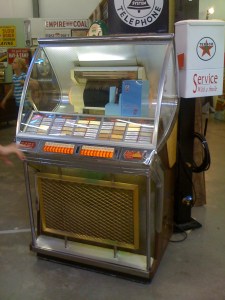
A really old iPod
The last time I was there, I overheard a teen ask her mom “What’s that?” as she pointed to grand jukebox. The mom’s reply made me chuckle: “That’s a really old iPod.” You never know what you’re going to see or hear.
I’m hoping the dealer with the old Christmas tree candle holders will be back this weekend. I think they’d be great to put on my tree this year to hold photos from Christmas’ past. If you happen to see any, shoot me a DM on Twitter: @carolpipes.
Happy junking!
Time catches up with 127 yard sale
It seems the Highway 127 Corridor Sale is not just for the casual junker or avid antique shopper. Time magazine found a gold mine of American nostalgia along Route 127. Check out these photos from the “world’s longest yard sale” and pick up a copy of the Aug. 23 issue.

Strangers in paradise
I’m still basking in the after-glow of the 127 yard sale. This big ol’ party was a gathering spot for strangers who share a love for antiques, junk and great deals. Isn’t it funny how a yard sale can turn strangers into a ragtag community? The camaraderie was contagious. Complete strangers shared memories over retro memorabilia, showed each other their purchases and gave recommendations on where to find a really good deal.
It was a couple of anonymous gents who helped push my car up a muddy incline. Of course, they may have had ulterior motives since they pulled into my parking spot as soon as I vacated it. But I’d like to think they’d have been just as helpful if they hadn’t need a place to park their truck.
At lunch, a crowded lunch spot—The Pig-n-Catch—necessitated sitting family style with other yard sale travelers. We sat with a couple from Wisconsin. What fun we had sharing our treasured finds over a shared plate of fried pickles. It was my idea for Mr. Wisconsin to order the pickles. He’d never heard of such a thing, if you can believe that. “Oh, you have to try the fried pickles,” I prodded. “You know, we fry everything down here.” He was hooked at the first bite.
Our lunch would have been humdrum if we hadn’t met our new friends. It’s amazing what you can learn about people over a plate of barbecue. Loving grandparents – he’s a novice guitar player and soon to be banjo picker; she a doll collector. We ran into them later on down the road and greeted one another like we’d known each other for years.
Obviously, we humans were not created for isolation, but instead for community. And it doesn’t take much to bring people together. Just a simple yard sale. I wonder if we’ll run into Mr. and Mrs. Wisconsin next year?
Yard Sale Heaven
I spent most of the past weekend traversing a small section of the 127 yard sale. Not familiar? It’s 675 miles of junkin’ fun. Known as the “world’s longest yard sale,” it runs from Gadsden, Ala., to Hudson, Mich. It’s fabulous!
My gal-pal Tara and I set out Friday night, spending a fun evening in Chattanooga, Tenn.. Then Saturday it was all business. Making our way North on Hwy 127, we managed to cover about 30 miles of the yard sale in about 10 hours. Yep, that’s right, 10 hours. Needless to say we took our time, carefully picking through piles of dishes, linens, old jars, and whatnot.
Yeah, there was a lot of junk. But there was plenty of treasure, too. And there were lots of deals to be had if you kept your eyes open and weren’t in a hurry.

Before
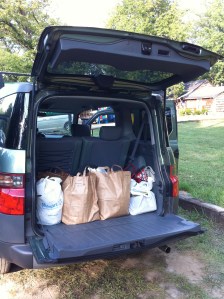
After
The whole day was a lesson in self-control. I think I mentioned in my previous post that I’m obsessed with dishes. Well, that obsession is not necessarily considered endearing to my husband, as one might think. He’s given me a moratorium on dishes. If I buy another set, I have to get rid of one. I walked away from several dish sets on Saturday. The hardest to walk away from were a beautiful set of green depression glass and another fun set from the ’70s with colorful poppies. But I was strong. And my husband is relieved.
I did manage to score a fun set of canisters (not technically dishes) for $12.

My favorite find
I’d walked away from these earlier in the day, but I just couldn’t get them out of my head. On our way home, we stopped to see if they were still there. I held my breath as I walked back to the table where I’d seen them before. I tried to contain my joy as I nonchalantly asked how much the vendor wanted for them.
Sometimes it pays to walk away. I wound up getting them for less than half what the owner had originally asked. And they look just as I imagined they would in my apple green kitchen.
I also found a $5 tablecloth with the same colors as the canisters. Score! My other favorite find was a 1960s tan handbag in “mint” condition. I carried it to work today. Just call me Doris Day.
All in all, it was a near-perfect day ( to be explained in a later post).
My friend and I are already making plans for next year’s sale. Kentucky, here we come!
 Carol Pipes